
Businesses are now actively filing their GSTR-1 returns after completing the GSTR-3B returns for the previous month. Proper reconciliation between these forms is critical to ensure accurate reporting and avoid any compliance issues.
Here is a detailed guide on matching GSTR-3B with GSTR-1 and GSTR-2:
Understanding GSTR-3B, GSTR-1, and GSTR-2
- GSTR-3B:
A summary-level interim return where businesses declare consolidated tax liability and eligible Input Tax Credit (ITC). It is designed for quicker compliance. - GSTR-1:
A detailed return that captures invoice-wise and rate-wise details of outward supplies. - GSTR-2:
A return for inward supplies, capturing the details of ITC claimed and tax liability on inward supplies under reverse charge.
Why is Matching Important?
The summary reported in GSTR-3B must align with the invoice-level details reported in GSTR-1 and GSTR-2 to ensure consistency in tax filings. Accurate matching ensures:
- Compliance: Prevents notices from tax authorities.
- Transparency: Minimizes discrepancies in ITC claims and tax payments.
- Seamless Process: Reduces errors while filing GSTR-3.
Steps to Match GSTR-3B with GSTR-1 and GSTR-2
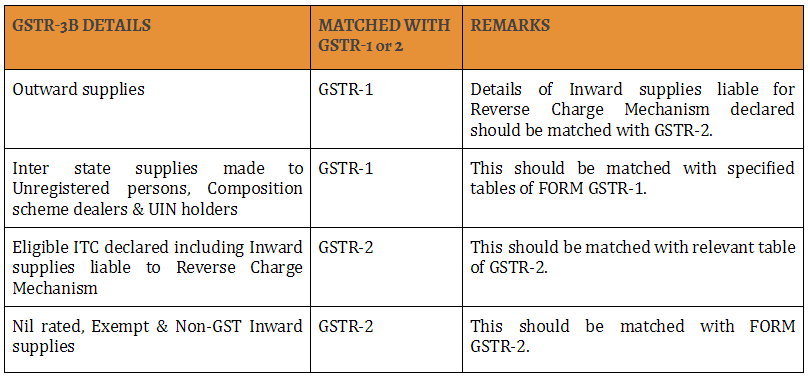
- Outward Supplies:
- Verify that the summary of outward supplies in GSTR-3B matches the invoice-wise details in GSTR-1.
- Exclude inward supplies liable for reverse charge while reconciling outward supplies.
- Input Tax Credit (ITC):
- Compare ITC details in GSTR-3B with those in GSTR-2.
- Ensure that the ITC claimed aligns with the tax liability reported for inward supplies under reverse charge.
- System-Populated Data in GSTR-3:
- Use the system-generated figures in GSTR-3 based on GSTR-1 and GSTR-2 to cross-check your reported data.
- Verify if the tax paid through the Electronic Cash Ledger and Electronic Credit Ledger while filing GSTR-3B is accurately captured.
- Handling Differences:
- If there are no discrepancies between the output tax liability and eligible ITC in GSTR-3B and the details in GSTR-1 and GSTR-2, proceed to submit GSTR-3 without additional tax payments.
- In case of differences, reconcile the data and pay any additional tax liability before final submission
Revised Deadlines
To ease compliance, the GST Council extended the filing deadlines for GSTR-1, GSTR-2, and GSTR-3 for the month of July. The extended deadlines offer much-needed relief to businesses, ensuring ample time for reconciliation and accurate filing.
Key Takeaways
- GSTR-3B serves as a bridge for interim compliance, but it must match with the detailed returns (GSTR-1 and GSTR-2).
- Regular reconciliation and validation of data reduce errors and ensure smooth GST filing.
- Businesses should utilize system-generated tools and reports for efficient reconciliation and filing.
The details of matching of GSTR-3B with GSTR-1 & GSTR-2 are shown below:
Accurate matching of GSTR-3B with GSTR-1 and GSTR-2 is essential for seamless GST compliance. Businesses must adhere to timelines and maintain thorough documentation to avoid any discrepancies or penalties.